Introductory Report
A summary of all your DNA health reports, covering disease risks, functional health, and performance.
Download sample report ›EVA™ screens more than 200 million genetic variants through OmicsEdge and delivers 14 reports across five categories, from methylation and detox pathways to inherited cancer and medication response.
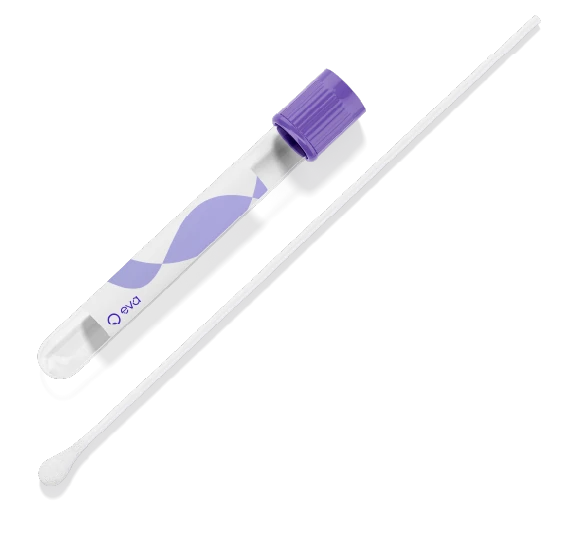
EVA™ by Elite Vita includes DNA analysis in its Elite DNA + Blood pathway in Dubai. Your analysis covers more than 200 million genetic variants (genotyped and imputed). Genetic information is considered alongside blood results and clinical review rather than used as a stand-alone prescription. Ask EVA about suitability and current availability; joining the website waitlist does not confirm a collection appointment.
Health DNA analysis can add inherited context to a conversation about your health. It cannot tell you with certainty what will happen to you, diagnose every condition or replace measurements of your current health. Genetic risk is not destiny, but it changes timing. A higher inherited risk is a reason to act earlier and more firmly on the factors you can change.
EVA brings DNA information into a wider assessment alongside blood results and the information you share. The useful question is what a finding changes about the conversation, not how impressive a report looks.
Ask whether DNA analysis fits your goals
Depending on the test, a report can describe selected genetic variants, associations or predispositions. The meaning depends on the methods, evidence and scope of that test. A reassuring result does not rule out every risk, and a raised genetic risk is not a diagnosis.
Ask which findings are suitable for general discussion and which require further clinical assessment or confirmation before action.
| Report focus | Main question | What to check |
|---|---|---|
| Health-related DNA | What inherited information may be relevant to my health discussion? | Evidence, limitations, review and any need for confirmation. |
| Ancestry | What can genetic comparisons suggest about my background? | Reference populations, scope and interpretation. |
EVA's published report menu includes ancestry alongside health topics. The presence of ancestry information does not mean every health question is answered by the same analysis.
EVA publishes a wider report menu than Vitl’s stated nutrition and wellbeing DNA offer, including dedicated methylation, pharmacogenomics and ancestry reports. Vitl does cover MTHFR within its folic-acid report, so it would be inaccurate to say it has no methylation-related content. A dedicated equivalent multi-gene pathway report was not established from the Vitl material reviewed. These are differences in published scope, not proof that one service is more accurate or produces better health outcomes.
Sources checked 15 October 2026: Vitl DNA test; Vitl FAQ.
EVA describes cheek-swab collection at home or at work in Dubai. Nothing in your mouth for one hour before collection, including food, water, gum and tobacco. Follow the collection instructions supplied for your kit or appointment. Ask the team about preparation, labelling and what happens if a sample cannot be processed.
Your DNA results appear in the EVA app in three areas. Methylation shows how well your body processes key nutrients such as folate and B12. Diet and Sensitivities shows how you are likely to respond to foods such as lactose and gluten. Disease Risks shows your inherited likelihood of conditions such as heart disease, as reduced, average or higher risk. Each result comes with a one-line explanation in plain English and, where relevant, an action. You can also download 14 detailed reports. A summary label is a starting point, not the entire explanation. Our DNA report walkthrough explains how to read a report without jumping from a label to a treatment decision.
Usually not. Your inherited DNA does not change, so one sample normally lasts a lifetime. What can change is the interpretation, as the evidence develops. A repeat sample and a new interpretation are different things. Ask whether a proposed repeat is needed because of sample quality, a different test or a specific clinical question. Also ask whether updated interpretation of existing data is available. Do not assume that a DNA test needs repeating on the same schedule as blood tests.
Review the genetic-data privacy questions and blood and DNA package comparison. Ask how clinically important findings will be handled and how you can discuss them with a qualified professional.
What your DNA reveals, and how EVA™ acts on it.
A summary of all your DNA health reports, covering disease risks, functional health, and performance.
Download sample report ›Reads eight genes controlling folate conversion, B12 absorption, homocysteine recycling and neurotransmitter clearance.
Assesses Phase I and Phase II liver detoxification, how efficiently you process toxins, medications and waste.
Evaluates cognitive resilience and Alzheimer's risk, including full ApoE genotyping with clear risk tiers.
Weighs inherited risk for coronary artery disease and stroke against more than a million variants each.
Examines predispositions to insulin resistance, Type 2 diabetes and energy-metabolism efficiency.
Examines genetic predispositions affecting digestive function, gut lining integrity, and sensitivity to specific foods and compounds.
Assesses genetic variants influencing testosterone pathways, oestrogen metabolism, cortisol regulation, and overall hormonal balance.
Evaluates inherited tendencies toward elevated inflammatory response and immune dysregulation across key pathways.
Reads your genetic response to carbohydrates, fats and protein, plus sensitivity risk for lactose, gluten and more.
Examines muscle fibre type, VO2 max potential, recovery rate and injury susceptibility.
Aggregates inherited risk across colorectal, prostate, breast, ovarian, lung, melanoma and pancreatic cancers.
Predicts how you metabolise cardiovascular, psychiatric, pain and other drug classes, and your adverse-reaction risk.
Maps your genetic heritage across global populations, providing context for your inherited background.
Download sample report ›Methylation underpins DNA repair, detoxification, neurotransmitter synthesis and homocysteine control. Each gene is reported as normal, slightly impaired, or significantly impaired.
23 genes comprehensively analysed. The 8 most impactful genes directly shape your protocol.
Converts folate into its active form for DNA repair and homocysteine recycling. The most clinically significant methylation gene, with variants in roughly 40% of people.
Regulates absorption of natural folate from food, so variants reduce dietary folate even on a folate-rich diet.
Converts synthetic folic acid into active folate inside cells. Variants mean standard folic acid is poorly used.
Recycles homocysteine back into methionine, a key control point for homocysteine levels.
Regenerates the active B12 that MTR needs, so variants stall the cycle even when B12 looks adequate.
Controls B12 absorption from the gut, so variants cause poor uptake regardless of intake.
Activates Vitamin B6 into its functional form for homocysteine metabolism and neurotransmitter synthesis.
Controls the breakdown of dopamine, adrenaline and oestrogen, shaping the stress response and oestrogen exposure.
The Alzheimer's result in the Brain Health report is driven by your ApoE genotype. EVA™ shows your allele pair and applies one of four tiers. This is a measure of genetic predisposition, not a diagnosis.
One or two protective alleles. Associated with below-average Alzheimer's risk.
Most common genotype. No E4 allele.
One risk allele.
Two risk alleles.
Most genetic tests look at single genes. A polygenic risk score aggregates signals from hundreds of thousands of variants across your genome to estimate your inherited risk for a specific disease, which a single gene cannot show. OmicsEdge's polygenic risk scores are published in Nature, covering heart disease, Alzheimer's, diabetes, and seven cancer types. Your EVA™ protocol is built with these scores as a foundation.
Join the EVA™ waitlist and be first when the app launches in Dubai.
No payment now. We'll be in touch with foundation-access details via WhatsApp, SMS, and email.
By joining, you agree to be contacted by Elite Vita about EVA™ early access via email, SMS, and WhatsApp. Your data is stored in the UAE under PDPL.